Have you ever cut your finger on a piece of paper? Are you sure it wasn’t a bite?
Bookwyrms are minuscule creatures native to warm and dusty environments, like old libraries.
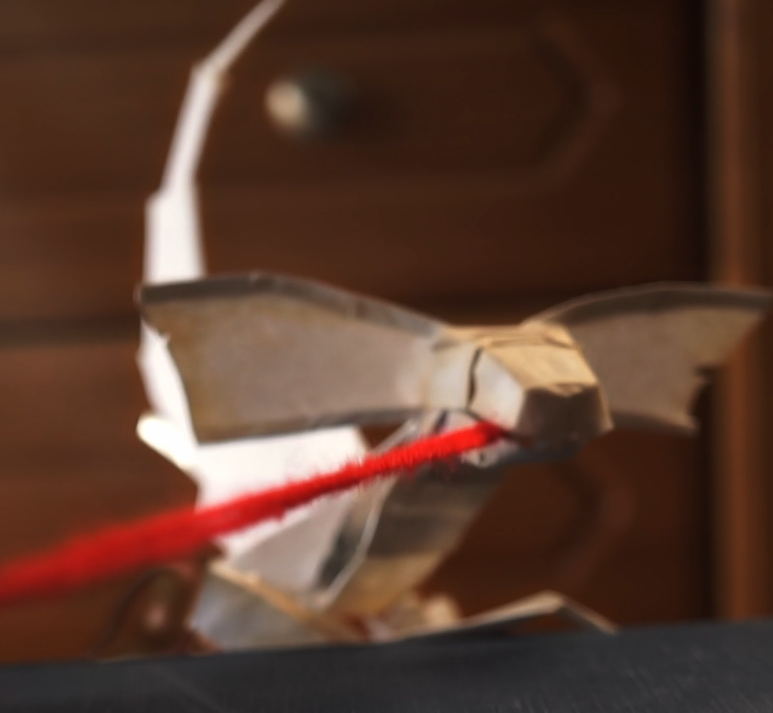
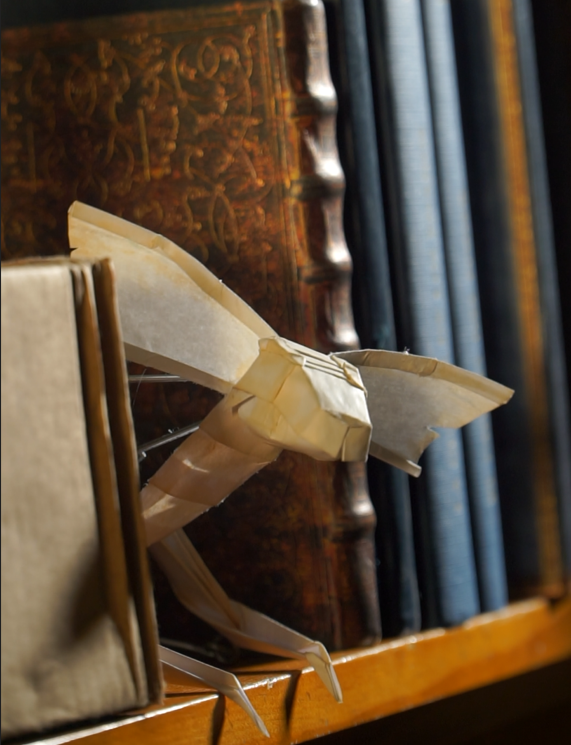
They look like folded pieces of paper, sometimes with lines drawn on them. I once saw a green bookwyrm in a study that had been taken over by vines.
Most bookwyrms take on either rodent-like or moth-like shapes, with long tails and sharp teeth right on the edge of their mouth.
Their diet consists almost entirely of paper, but they can also feed on other plant-based materials if they must.
The bookwyrm pictured here is my pet Paige. I took her in as a baby and took care of her for twelve years. Most of my behavioural observations are based on her, so take these with a grain of salt:
- They prefer paper with words in it. Red ink is better than black ink, and blue ink is just fine. Don’t feed them pictures.
- They’re extremely timid, and will hide from people they don’t know. They can squeeze between a book’s pages and lay almost flat, but it’s not healthy for them to spend too much time compressed.
- I initially tried to do some research on music and its effect on them. After years of trying with classical, EL, EDM, BWFM and rock, I finally concluded that they have terrible taste and I don’t care.
Bookwyrms can’t digest ink and will become bloated if fed too much of it. They can, however, spit it back out kind of like a squid would, and will not hesitate to do so in self-defense. It’s still much better than a bite, unless you’re wearing a super cool vest that you made so you could match your best friend’s outfit to go to a lunch out in the park.
Contrary to popular belief, bookwyrms are not paper, and do need to drink water to survive. So if you’re planning to keep one as a pet, make sure you take care of them appropriately. And don’t forget to bathe them!
Every bit counts. Consider supporting the show. Thank you 🙂